
Ada County Address History Sources
No Ada County agency keeps a master list of every person who ever occupied a home. A resident lookup has to cross several systems. The Assessor hands you the parcel number, situs address, and legal description. The owner shown for a chosen assessment year comes with it. The Recorder holds the recorded instruments that tie one owner to the next. Boise city directory volumes then put named people and firms at dated addresses. Census schedules can round out a household. Sanborn maps and permits describe the place itself rather than its people. Pick your source by era and by the question at hand.
| Source | Years It Covers | Where Held | What It Shows |
|---|---|---|---|
| Recorder instruments | County era from 1864; online extent varies | Ada County Recorder and Tyler | Deed parties, dates, legal descriptions, instrument links |
| Boise directories | Runs begin in 1891; holdings vary | Boise Public Library and Idaho State Archives | Dated names, addresses, firms, and occupations |
| Hill-Donnelly reverse directories | Selected twentieth-century volumes | Boise Public Library local history collection | Address-first listings and nearby entries |
| Federal census schedules | Public through 1950 under the 72-year rule | Archives and library databases | Households, relationships, age, and residence |
| Sanborn maps and permits | Sanborn editions 1884-1956; permit coverage varies | Library of Congress and City of Boise | Building footprint, use, alterations, and dated contacts |
Match the source to the era. A modern question starts with the current parcel and deed. For a mid-century Boise address, try a reverse street directory first. Then compare census and permit records. Before 1891, lean on deeds, court and probate files, tax rolls, newspapers, church records, and cemetery sources. Idaho vital registration shifts by period as well. County registration began in 1907, statewide birth and death coverage in 1911, and state marriage and divorce certificates in May 1947.
Ada Recorder Search Reality
The Ada County Clerk Records Public Access Web opens with terms of use. Its own notice compares the index to a library card catalogue. It tells users to try spelling variations and multiple search criteria. That advice matters. The same prior owner can appear under initials, a middle name, or a trust. A changed surname may also appear. The county has also announced a multi-year project to redigitalize historic records from 1864 through 1996. It will index those years as well. That project does not guarantee that every instrument in those years is searchable. Nor does it promise every one is imageable online. The Recorder publishes no stated cutoff for the online deed index. When a search returns no likely deed, keep the parcel number handy. Also keep the legal description, approximate date, and party name variants. Then ask the Recorder to check the underlying book, image, or index. The official Tyler notice appears in the portal screen below. Read it before treating any search result as the document itself.
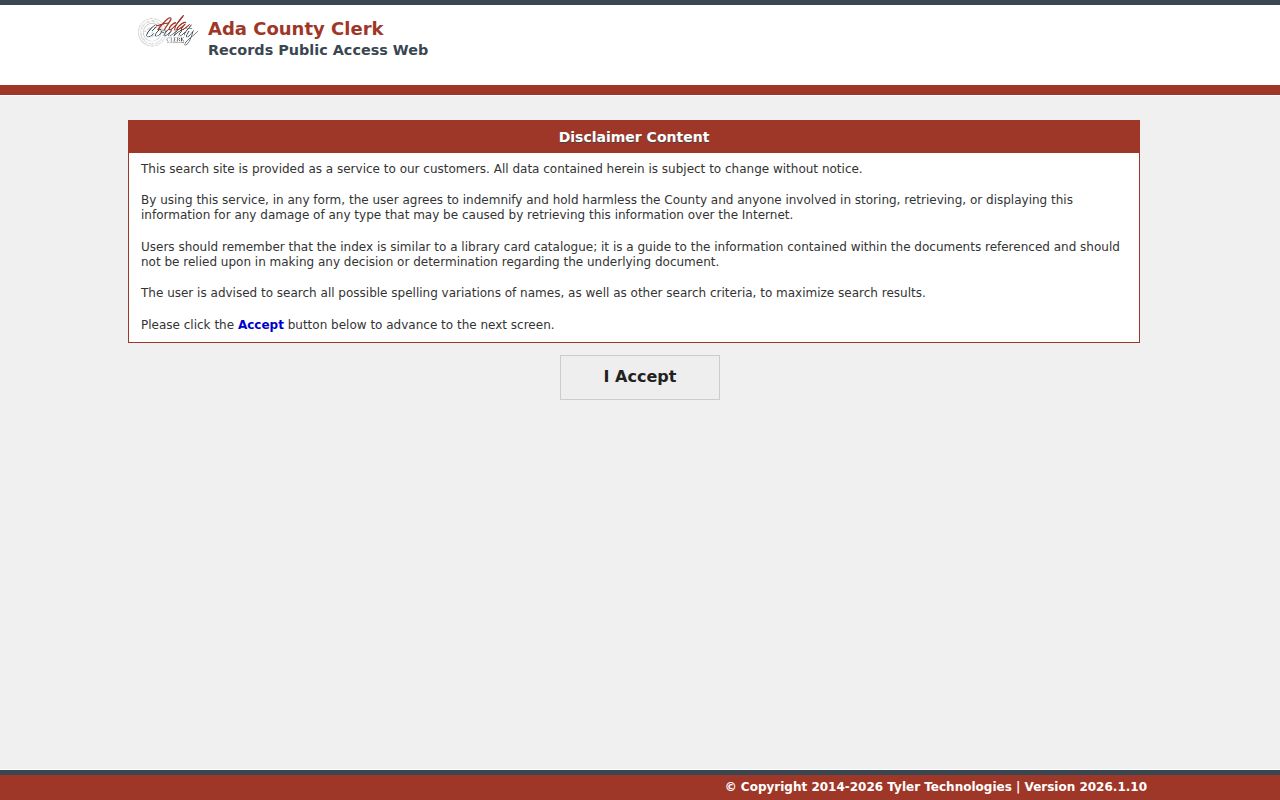
The screen underscores one rule for any Ada County address history: use the catalogue to find an instrument, then inspect the recorded document or request a custodian copy.
Note: A failed online result is a reason to use the Recorder counter, not proof that no deed exists.
Walk Ada County Deeds Backward
Start an Ada County deed walk with the Ada County Property Lookup, which turns a street address into a parcel number and legal description. The public search offers Address, Parcel, and Subdivision tabs. The screen carries no current owner-name field. Once a parcel opens, the card can display the selected year, situs address, shown owner, subdivision, and legal text. A situs address is the physical location. It may differ from the mailing address.
- Search the address and save the exact parcel number, legal description, situs address, subdivision, and assessment year.
- Use those stable identifiers and the displayed owner to locate a likely purchase instrument in Tyler.
- Read the deed. Record the grantor, grantee, recording date, instrument number, and legal description.
- Search the seller as a grantee in an earlier period. Repeat the check while matching the same land description.
- When the web trail ends, contact the Recorder at 200 W Front Street, Room 1207, Boise, or call 208-287-6840 for counter and copy routes.
- Grantor and grantee
- The grantor transfers an interest; the grantee receives it.
- Chain of title
- The linked sequence of recorded transfers for the same land.
- Legal description
- The formal lot, block, subdivision, or survey description. It can remain useful after a street number changes.
An owner is not automatically an occupant. Trusts, firms, agencies, estates, and common-area associations all show up on parcel cards. Keep the role labeled as selected-year parcel owner until a directory, census, or obituary places a real person at the address.
Ada Address Grid Clues
Ada County addresses sit on four directional grids. Numbers climb outward from a central point. Land Records manages addressing in unincorporated areas. The exceptions are the Boise area of impact and the cities of Eagle, Star, Garden City, and Kuna. So an address inside city limits may fall under municipal records. Even so, every street name routes through county Land Records. When an old directory listing vanishes, check the Street Naming and Addressing office. Also check the official grid map and the current street-name search. The current-name tool is not a historical renaming index. A predirection, road-type change, private-road shift, plat sequence, or renumbering can break an exact match. Pin the old directory entry to a legal parcel, block, and map first. Only then conclude that previous residents actually moved.
Address flow. Old listing → grid and street check → legal parcel → deed instrument → dated occupant source.
Boise Maps Add Building Time
Boise Sanborn fire-insurance editions from 1884, 1888, 1893, 1903, 1912, and 1956 can reveal a building's footprint, use, and block context. They do not name every occupant. The strongest play is to set a dated directory entry beside the sheet for the same block, then check a permit or historic-site inventory for structural change. One City of Boise historic inventory for 1714 North 11th pairs a 1912 Sanborn sheet with pasteovers through 1949, a 1940 permit naming John R. Scott, and directory citations. Another inventory places Frank A. King and King's Auto Repairs at 1702 Fairview Avenue in the 1939 and 1958 directories. Treat these as leads. They are no substitute for the original map, directory page, permit, or deed. The method works because each item supplies both a date and a role. Open the 1714 North 11th historic-site packet or the City of Boise Fairview Avenue inventory, then verify any key claim in the source each packet cites.
Ada Previous-Resident Access Fallbacks
Every address search eventually hits a wall. A portal returns nothing. Or it offers only a bare index reference, with no image behind it. That is not the end of the road in Ada County. The Recorder's office can still work from a narrow, well-built request. Build yours around the parcel number and the legal description. Add an instrument number, spelling variants of the party name, and the document type. Include a tight date range too. The counter sits at 200 West Front Street, Room 1207. It is open weekdays from 8:00 a.m. to 5:00 p.m. For questions about deed books, underlying images, or certified copies, that office is the custodian to ask. Other Ada County institutions can catch what the Recorder cannot. The Idaho State Archives takes research requests by email, phone, and in person. Boise Public Library staff can search the local-history shelf and its licensed databases. City planning or clerk staff can pull a specific permit or historic file. A written Idaho Public Records Act request should name the record precisely. It should also give the date as closely as possible. Ask for one address rather than every resident record. That focus also keeps you clear of Idaho's limits on mailing and telephone list uses.
Fallback chain. Portal index → Recorder counter or copy request → library and Archives catalogs → named city permit or historic-file custodian.
Ada Address Trail Endpoints
An address trail in Ada County can stop for several reasons. A past resident may have died. An estate may have transferred the property. Or the person simply moved past the directory run you have. Probate is often the next stop. Search iCourt by party name or case number for an Ada probate lead. Then request the actual public file from the Clerk under Idaho Court Administrative Rule 32. Court indexes and docket summaries are not the filed will, petition, order, or deed. Sealed and restricted material stays off limits. Death and relocation leave other traces. Pair the last dated directory entry with the library's obituary and clipping indexes or the Archives newspaper routes. The Idaho State Veterans Cemetery runs an official grave locator for its Boise grounds. It is not a countywide burial index. No complete official online name index covers all Boise or Ada County cemeteries. Treat any single hit with care. A memorial entry, obituary, probate party, or cemetery plot marks just one dated role. So confirm the person against another anchor like the exact address, a middle initial, a relative, a deed instrument, or the directory page itself. An endpoint check can explain a gap honestly. Record the final confirmed year and its source. Then mark the next period unresolved rather than inventing a later address.
Ada Previous Residents by Household
Deeds answer who owned a property. For who lived there, the address-first sources work better. The Hill-Donnelly volumes, Polk directories, old telephone books, and census schedules all place past residents at a specific address. That address is in Ada County. The Boise Public Library local-history collection holds these practical address sources. It also offers staff research help. Its stated directory-copy service costs $1.25 per page, capped at five pages per week. Full details on the broader Ada County city directory collection belong on the historical shelf page. Here, treat each volume as one dated checkpoint in a single property's trail.
- Search the address in the closest available reverse directory year. Copy the full page citation, not just a name.
- Move one volume earlier and one later. Note spelling, spouse, firm, and vacancy changes without merging identities.
- For a public census year, locate the enumeration district, the geographic area used to organize the count, then inspect nearby schedule lines.
- Compare directory and census names to deed parties, permits, newspapers, and obituaries. Require at least two anchors for a common name.
The Idaho State Archives catalogs widen the trail with newspaper, biographical, library, and digitized-collection routes. Research requests can go to public.archives@ishs.idaho.gov or 208-334-2620. Probate files are court records under Idaho Court Administrative Rule 32. When an estate may connect heirs to an Ada County address, search iCourt and request the actual file from the Ada County Clerk.
Lawful use. Ada County previous-resident records support house history, genealogy, and estate research. Never use an address trail to track, harass, or defeat a protected person's privacy.
Note: Keep owner, occupant, directory listing, permit contact, and obituary subject as separate roles until the dates and address agree.